


WHO WE SEE · BUSY PROFESSIONALS
For Busy Professionals
You don't have time to be unwell. You also don't have time to keep ignoring the signals your body is sending. The practice is five minutes from your desk. A session fits inside a lunch break. And the effects tend to last considerably longer than that.
You recognise this
The neck that tightens by mid-morning and doesn't release until the weekend, if at all. The shoulders that live somewhere near your ears. The headache that arrives reliably on the third consecutive day of back-to-back meetings. The sleep that doesn't quite restore you, so you arrive at Monday already running a deficit.
And beneath all of that, a more persistent quality: a low-level hum of activation that doesn't switch off when the laptop closes. The inability to fully decelerate. The feeling of being simultaneously exhausted and unable to rest.
This isn't a personality type. It isn't weakness. It is what happens to a nervous system that has been operating in sustained high-demand mode, absorbing the physical load of desk work, the postural strain of long hours, and the neurological cost of constant cognitive pressure, without adequate opportunity to unwind.
The body keeps a precise account of all of it.
The physical side of a desk career
Sitting for extended periods does specific things to the spine. The head moves forward of its natural position, and for every centimetre it does, the load on the cervical spine multiplies. The upper back rounds. The hip flexors shorten. The lower back compresses. The breathing shallows as the ribcage loses its natural range.
These changes accumulate gradually, which is precisely why they're so easy to miss until they become impossible to ignore. What begins as a mild stiffness at the end of the day becomes chronic tension that is present on waking. What begins as an occasional headache becomes a predictable feature of the working week.
The body is adaptive. But adaptation has limits, and when those limits are reached, the nervous system starts to reorganise around protection rather than ease. That reorganisation has consequences that reach well beyond the spine.
The tension you carry out of the office doesn't stay at work. It comes home with you, sits at dinner with you, and is there again when the alarm goes off.
What's actually happening
Stress, whether it's the pressure of a deadline, a difficult conversation, or simply the relentless pace of a busy week, doesn't stay in the mind. It settles into the body. Into the spine, the shoulders, the jaw, the diaphragm. The nervous system registers it as a physical event and responds accordingly, tightening, bracing, and preparing for a demand that may never arrive.
Over time, this braced quality becomes the baseline. The nervous system stops distinguishing between active threat and ordinary day. It simply stays on. The result is a body that never fully recovers between demands, sleep is lighter, energy is less consistent, and the physical symptoms that seemed manageable six months ago have quietly become the texture of every day.
This is not a problem that resolves with another weekend, a holiday, or an app that reminds you to breathe. It requires something that works directly with the nervous system, not around it.
Understanding how stress is stored in the nervous system
How stress gets stored in the body
How the work here is different
WellWellWell Sydney is five minutes walk from most of the CBD. A session fits comfortably within a lunch break. And the approach, Network Spinal, a gentle, precise method that works directly with the spine and nervous system, is specifically suited to people carrying the accumulated physical and neurological load of a demanding professional life.
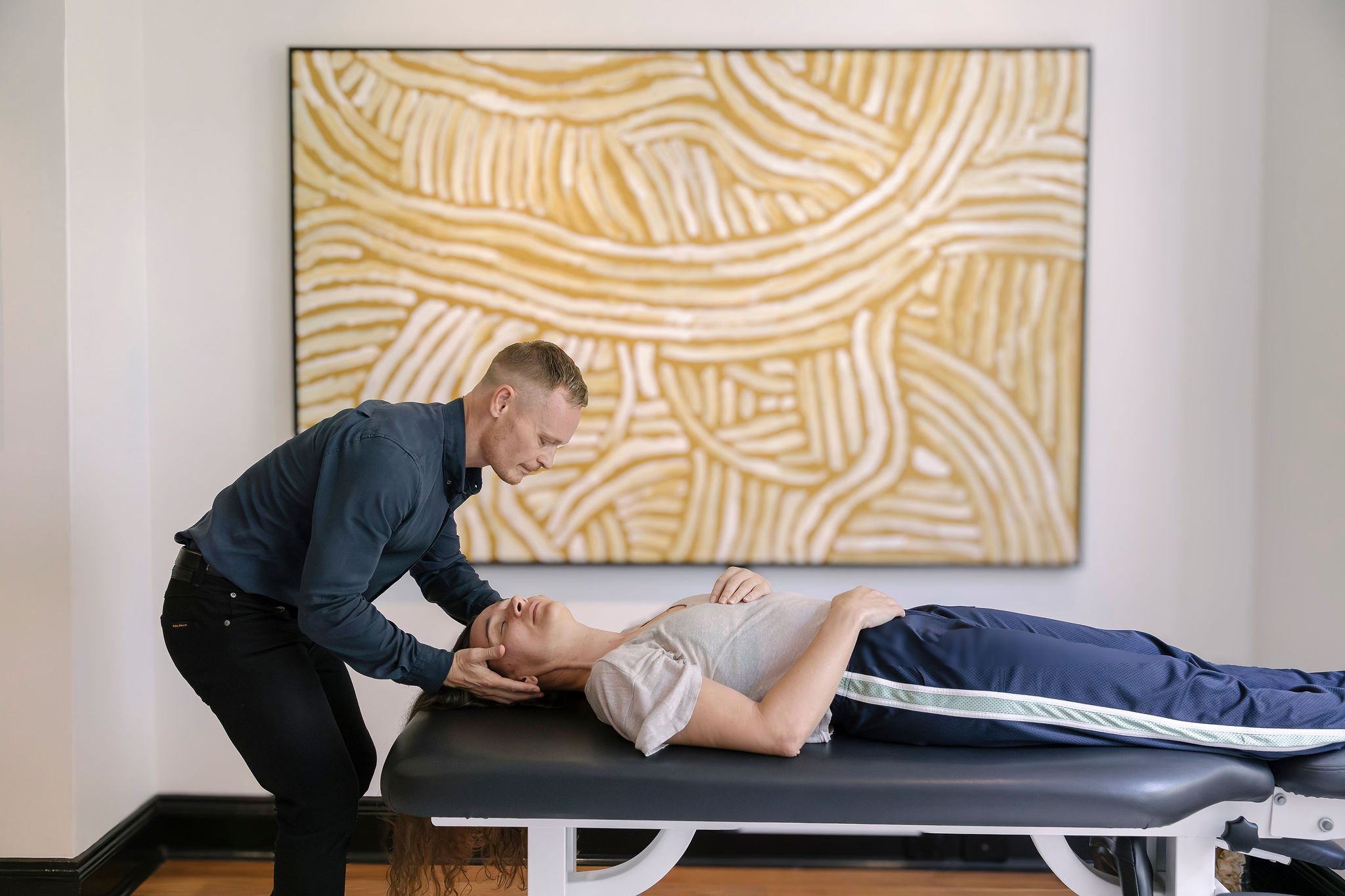
Network Spinal uses light, precise contacts along the spine, no manipulation, no cracking, no force, to help the nervous system recognise where it's been holding tension and begin to release it. Many patients describe a noticeable shift in the quality of the afternoon following a session: clearer thinking, less reactivity, a physical ease they'd forgotten was possible on a working day.
For patients who prefer or benefit from more traditional manual chiropractic adjusting alongside nervous system care, that's available too. Care is always tailored to you, your body, your history, your schedule, and what you're hoping for. There is no fixed protocol.
About gentle Chiropractic and manual adjusting
The practical details
The practice is at 185 Elizabeth Street. Opposite Hyde Park, a short walk from Town Hall, St James, and Gadigal Metro stations. It is the kind of location that makes fitting care into a working day genuinely possible rather than aspirational.
Follow-up sessions typically run between twenty and forty minutes. The first visit, which includes a full conversation, assessment, and initial session, takes around sixty to seventy-five minutes and is available on Wednesday afternoons and Thursday mornings. Many patients schedule their first visit at the start or end of a working day and return for follow-up sessions during the week.
No referral is required. You can book directly, online, in minutes.
What happens at your first visit
Fees and health fund information
Common questions
Can I really fit this into a lunch break?
Follow-up sessions run between twenty and forty minutes. Combined with the walk from most CBD offices, it fits comfortably within an hour. Many patients do exactly this, once or twice a week, as an ongoing part of how they manage the demands of their work life. Your first visit takes longer, allow 60-75 minutes, and is best scheduled at the start or end of a working day.
I'm not in pain, is this still relevant for me?
Yes. Many of the patients Dr Euan sees are not in acute pain. They're carrying tension, running below their energy baseline, sleeping lightly, or noticing that they've lost access to the sense of ease and resilience they used to have. These are the people this kind of care is particularly well suited to, before the body has to raise its voice to be heard.
How is this different from massage or physio?
Massage and physiotherapy work directly on muscles and joints, effective for what they do. Network Spinal works with the nervous system itself: the part of you that controls how muscles hold tension, how the body responds to stress, and how quickly you recover between demands. For many professionals, the change they notice is less "my back feels better" and more "I feel like myself again"which tends to be a more durable shift.
Will I need to come back constantly?
Dr Euan will give you an honest picture of what he'd suggest and why after your first visit. Some people come in for a focused period of care and then taper to occasional visits. Others find that regular sessions, once a fortnight or once a month, become part of how they maintain their capacity to function well under sustained pressure. There is no obligation beyond the first visit.
Does private health cover it?
Private health extras cover may apply depending on your fund and level of cover.
See fees and insurance information
Your body has been keeping score
The first visit takes about an hour. The conversation alone tends to be worth it. No referral needed — just book a time and come in.