What Actually Happens to Your Spine and Nervous System During Network Spinal Care
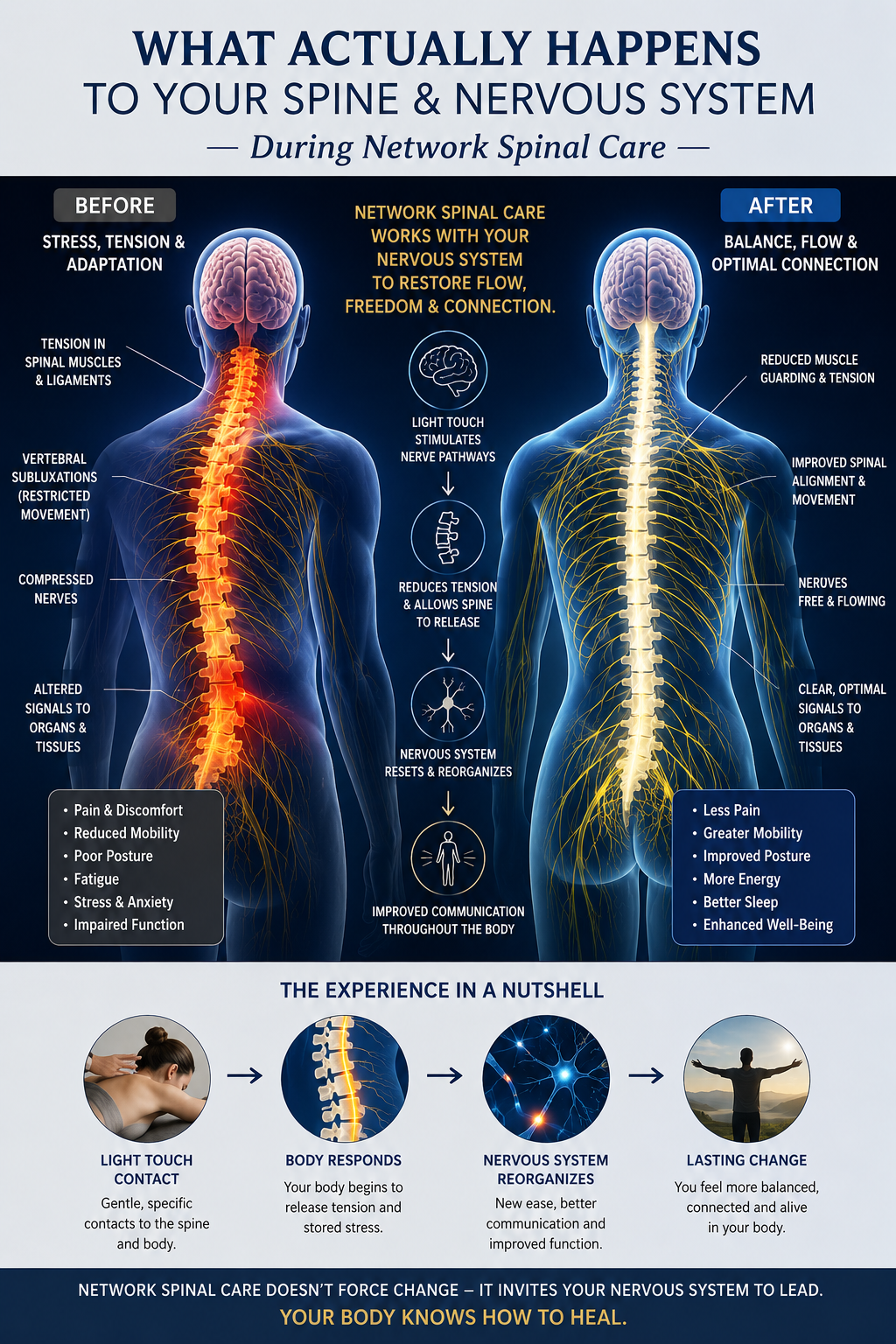
Rather than adjusting the body forcefully, Network Spinal Care uses gentle spinal contacts to help the nervous system release tension and restore its own natural communication and ease. The changes that follow tend to be cumulative — in posture, stress, mobility, sleep, and energy.
By Dr Euan McMillan | WellWellWell Sydney
Most people who come to see me have already tried something. Physio, massage, standard chiropractic, medication. They've had some relief, maybe, but the pattern keeps returning — the tight shoulders, the low back that seizes up under stress, the sense that their body is braced for something that never quite resolves.
What they're describing, without always having the language for it, is a nervous system that's learned to hold tension rather than release it.
Network Spinal works with exactly that pattern. And understanding what's actually happening — not just in vague terms, but mechanically and neurologically — is worth your time before you book.
Your Nervous System Is Running an Old Program
Your spine and your nervous system are inseparable. Every posture you hold, every bracing response to stress, every pattern of tightness in your body — these are expressions of how your nervous system is organising itself based on everything it's experienced.
When the system encounters stress it can't fully process — physical injury, sustained emotional pressure, accumulated tension over years — it doesn't just forget. It stores it. The musculature along the spine contracts, the breath shortens, and posture subtly shifts to protect what feels vulnerable. Over time, these become your baseline. The bracing becomes invisible because it becomes normal.
The research term for this is allostatic load — the accumulated cost of chronic adaptation. The body is doing its job, but it's working harder than it needs to, on patterns that were laid down years ago and haven't been updated since.
What Network Spinal Actually Does
Network Spinal Care uses gentle, precise contacts along specific points of the spine — primarily at the base of the skull and the sacrum — to introduce new neurological information into the system.
These contacts aren't forceful. There's no cracking, no manipulation in the conventional sense. What they do is create a shift in the tension pattern across the spinal cord and the connective tissue surrounding it, signalling to the nervous system that it's safe to reorganise.
What often follows is something practitioners call the respiratory wave — a spontaneous, wavelike movement that begins in the breath and travels through the spine. Patients frequently describe this as a sense of unwinding, or of the spine moving in a way it hasn't moved in years. This isn't a technique being applied to the body from outside. It's the body finding a release strategy it couldn't access on its own.
With repeated sessions, a second, more dynamic pattern tends to emerge — what's sometimes called the somatopsychic wave. This represents a deeper reorganisation: the nervous system beginning to integrate and discharge tension that had been locked into the tissues, not just compensating around it.
The 'Energy' Question
I want to address this directly, because it's the thing some people find confusing or off-putting when they first read about Network Spinal.
You'll sometimes see this work described in terms of "spinal energy" or "energetics." These terms come from the original theoretical framework developed by Dr Donald Epstein, and they describe something real — but that reality is better understood, for most people, through the lens of nervous system physiology.
When we talk about energy in this context, we're largely talking about:
Neurological efficiency — how much energy your system is spending on chronic tension patterns versus available for repair, clarity, and function
Autonomic regulation — the balance between your sympathetic (stress) and parasympathetic (recovery) nervous systems
Somatic coherence — how well different parts of your body are communicating with each other through the neural network
The shift people experience — the sense of being lighter, more present, more at ease in their body — has a physiological basis. It's not mystical, even when it feels profound.
That said, I won't pretend the experience is purely mechanical. When a system that's been braced for years finally finds a different way to organise itself, people often notice changes well beyond their physical symptoms: better sleep, less reactivity to stress, a different relationship with their body. The research out of the University of California documented this across multiple dimensions of health and wellbeing. The effects are real, and they're often larger than people expect.
What to Expect as You Progress
Network Spinal Care is typically delivered in stages. Early sessions focus on helping the nervous system find its first release strategies — the respiratory wave. This is the foundation. Without it, deeper reorganisation isn't possible.
As that pattern becomes more established, sessions shift toward integrating the changes and building what you might call nervous system resilience: the capacity to encounter stress and move through it, rather than absorbing and storing it.
People who stay with the care long-term consistently report that what began as symptom relief evolved into something broader — a different baseline. Less tension as a resting state. A body that recovers more quickly. A greater sense of choice in how they respond to what life brings.
Who This Is For
Network Spinal tends to be particularly well-suited for people who:
Have chronic tension or pain that hasn't fully resolved with other approaches
Recognise that stress plays a significant role in their physical symptoms
Are curious about what their body is capable of when the nervous system is well-regulated
Have had unsatisfying experiences with more forceful forms of manual therapy
Are interested in long-term wellbeing, not just short-term relief
It's also genuinely appropriate for people who are simply well and want to stay that way — who understand that the nervous system, like any other system, functions better with care and attention than without it.
A Note on My Approach
I've been practising Network Spinal Care for over 20 years, and I hold a Master-E certification — the advanced level of training in this method. I mention this not to collect credentials but because the quality of the contact matters enormously in this work. The precision with which these spinal gateways are engaged determines whether the nervous system gets the signal it needs to reorganise, or simply receives pressure.
There's no rush, and there's no formula applied regardless of where you are. The work is specific to you and your nervous system, your history, and where you are on any given day.
If you'd like to understand more before booking, I'm happy to answer questions directly. Or if you're ready to experience what your nervous system is capable of, you can book a first visit below.
Dr Euan McMillan is a Chiropractor practising Network Spinal Care at WellWellWell Sydney, Suite 301, 185 Elizabeth Street, Sydney CBD.
About the Author
Dr Euan McMillan
Dr Euan McMillan is a Sydney Chiropractor with over 20 years of experience and a Master-E certification in Network Spinal. He serves on the Network Spinal international teaching staff and works with an interest in nervous system regulation, stress physiology and chronic tension patterns. His approach centres on gentle, non-force care at WellWellWell in Sydney's CBD. Read more about Dr Euan.
Continue Reading
Sydney CBD
Ready to feel the difference?
Suite 301, 185 Elizabeth Street, Sydney. New patient visits on Wednesday afternoons and Thursday mornings.